other brother Ezra, who had taken over from Sheikh Sasson as Nasi, was imprisoned.
Dawid Sasson would not stand for the position of
Nasi, but was, nevertheless, effectively the de-facto spokesman of the community and was held in great esteem. Sadly, his wife Hannah died, but not before giving him four children, Mazal Tob, Abdallah (Albert), Eliyahu (Elias) and Ammam. Dawid then married Farha Hayeem in 1828.
Daud Pasha was constantly on the look out for ways to satiate his craving for money and it took but a few months for him to find an excuse to imprison Dawid Sasson. At the very same time, the Pasha's former colleague and
Nasi, Ezra (the second brother), was removed from his cell and killed.
This not so subtle hint was not missed by Sheikh Sasson who paid an enormous ransom to Daud Pasha to free his son, with the condition that his son Dawid would leave by the next boat to Basra.
Not trusting the Pasha, they did not wait for the next scheduled sailing, but within hours of his release Sheikh Sasson paid a significant sum to charter a boat to take his son, immediately, to Basra.
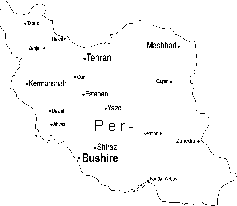
The trip, in those days, took about five days, and Dawid Sasson arrived in Basra in the evening. Heeding his father's advice, the very next day he set sail for Abushaher (Bushire) in Persia, a port city on the Persian Gulf (about 400 kilometers

south of Teheran).
Their suspicions proved to be well-founded. The next scheduled sailing brought Daud Pasha's officials with orders to bring Dawid back to Baghdad. They searched Basra for him, but Dawid Sasson was now in Persia.
He wasted no time and

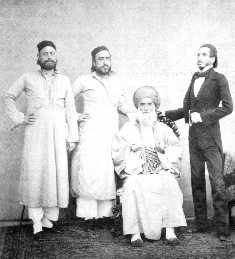
Dawid Sasson (David Sassoon) seated, with (L-R) Elias & Abdallah from his first marriage and Sasson (from his second marriage). Dawid Sasson was against wearing western dress, however, Sasson was shortly to open their London branch.

the Sassoons. He made an investigative trip there and was welcomed by the community.
His research and inquiries confirmed his opinion that there were many opportunities in India. He returned to Bushire and pursued those contacts which would be beneficial to him in Bombay and, with some financial backing from the Zacharia family, Dawid Sasson and his family left for India.
David Sassoon moved to Bombay in the early 1830's and began trading. Choosing not to reinvent the wheel, he entered into already tried and tested markets, trying to learn from his competitors' failures. He started with a small counting house and warehouse and was soon buying up wharfages. Eventually, he was importing and exporting all manner of merchandise.
By the late 1850s it was said: "whatever moves over land or sea bears… the mark of Sassoon and Company".•

(To be continued.)


soon began trading from a small warehouse which belonged to the Zecharia family who originated from Shiraz. Initially, he was a middleman in the transactions, but gradually began to import and export varied cargo, from pearls to silks and other items.
Eventually, Dawid Sasson's family, including his now elderly father, Sheikh Sasson, also came to Bushire. Most of the vast Sassoon wealth, however, remained in Baghdad. Sheikh Sasson passed away in 1829. Abdallah had his Bar Miswah there, and one would have understood if Dawid Sasson had become used to the idea of remaining in Bushire.  However he began to set his sights on something bigger --  Bombay.
Bombay was rapidly developing into a major commercial trading center and he felt that it would offer him many more opportunities than Bushire. There was already a small Baghdadian community there from the emigration that began in the late 1800's but which flourished later under

Page 3             

© Copyright  Midrash BEN ISH HAI ™  --  Where Our Heritage Lives™            (516) 487-6676

HOME                                                                  www.midrash.org